


In January 1993, at the Detroit Auto Show, Porsche unveiled a concept car that not only captivated the automotive world but also altered the company’s fate. The Porsche Boxster Concept was more than a show car—it was a lifeline for a brand on the brink of extinction. Inspired by the glorious 550 Spyder of the 1950s and designed to attract a new generation of enthusiasts, this mid-engine roadster laid the foundation for the Porsche Boxster (986) and redefined Porsche’s DNA for the 21st century.
Context: Porsche on the Edge
By the early 1990s, Porsche was in crisis. Sales of the 911 had plummeted, and front-engine models like the 968 and 928 failed to resonate with new buyers. The company was hemorrhaging money, and speculation about bankruptcy swirled. In this dire context, a team led by Wendelin Wiedeking (later CEO) made a radical decision: to create an accessible roadster that fused Porsche’s heritage with modern technology.
The project was named Boxster—a blend of “Boxer” (referencing its flat-six engine) and “Roadster.”
Design: A Nod to the 550 Spyder, Eyes on the Future
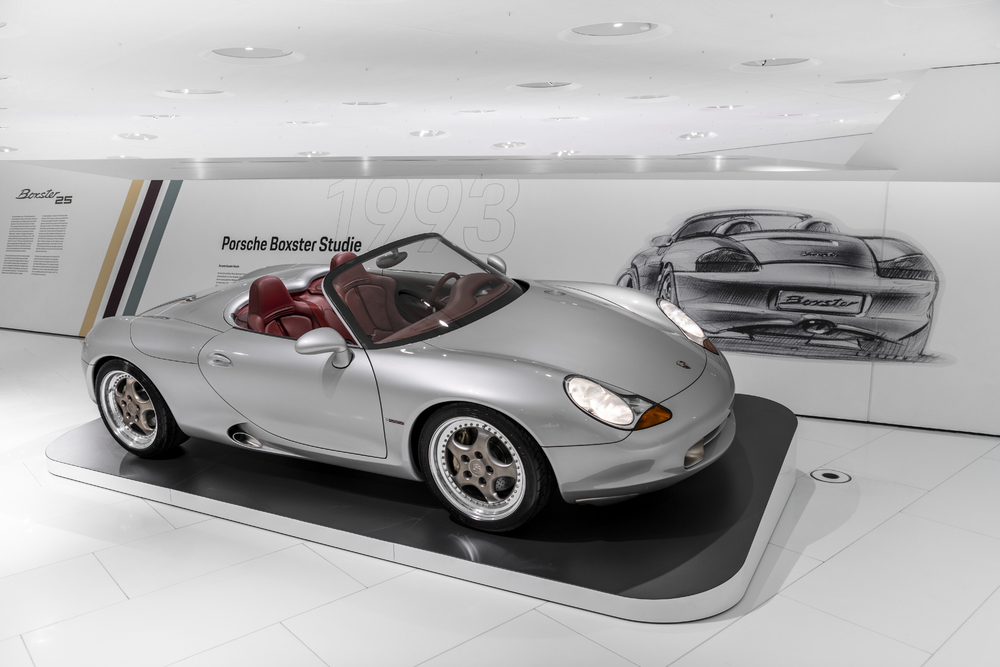
Designed by Grant Larson under the guidance of Harm Lagaay, the Boxster Concept stunned with its retro-modern aesthetic. Its curvaceous bodywork, flared fenders, and oval headlights evoked the spirit of the 550 Spyder, but with aerodynamic lines and futuristic details.
Key Design Features:
- Integrated Oval Headlights: A bold departure from Porsche’s classic round lamps, previewing the radical redesign of the 996-generation 911.
- Short Hood and Long Rear Deck: A mid-engine layout emphasizing perfect weight distribution.
- Minimalist Interior: A three-spoke steering wheel, blue-tinted analog gauges, and leather seats with vintage-inspired stitching.
- Seamless Soft-Top: Retracting cleanly under an aluminum tonneau cover, with no visible framework.
The design was so well-received that the public demanded its immediate production—an unusual reaction to a concept car.
Technology & Performance: A Glimpse of the Future
Though the Boxster Concept wasn’t built for speed, its specifications hinted at Porsche’s future direction:
- Mid-Engine Layout: A naturally aspirated 2.7L flat-six producing 204 horsepower—similar to the production Boxster (though less powerful than the later S variant).
- 6-Speed Manual Transmission: An innovation for Porsche at the time.
- Active Suspension: Experimental tech that adjusted stiffness based on driving conditions.
While many of these features were simplified for the production model, the concept proved Porsche could innovate without betraying its identity.
Reception: Detroit Falls in Love Again
At its debut, the Boxster Concept became the star of the Detroit Auto Show. Journalists praised its daring design, while potential buyers clamored for details on pricing and availability. The concept also caught the attention of investors, giving Porsche a crucial financial boost.
“The Boxster isn’t just a car—it’s a statement that Porsche can evolve,” wrote Car and Driver.
Legacy: From Concept to Icon
The Boxster Concept played three pivotal roles:
- It Saved Porsche from Bankruptcy: Its success convinced Porsche’s board to greenlight the 986 Boxster, launched in 1996.
- It Modernized Porsche’s Design Language: The oval headlights and curvaceous silhouette influenced the 996-generation 911 and remained relevant for decades.
- It Democratized the Brand: The production Boxster’s accessible price brought Porsche within reach of everyday enthusiasts.
Today, the concept is displayed at the Porsche Museum in Stuttgart as a symbol of the brand’s renaissance.
FAQ: Quick Facts
Q: How many Boxster Concept models were built?
A: Only one, displayed in Detroit.
Q: Why was there no Porsche badge on the hood?
A: The clean design was intentional—badges appeared only on the wheels and steering wheel.
Q: What features were dropped for production?
A: The active suspension, blue-tinted headlight lenses, and exotic interior materials.
Conclusion: The Concept That Rewrote History
The 1993 Porsche Boxster Concept wasn’t just a beautiful car—it was an act of desperation and genius. It reminded the world that Porsche could innovate without losing its soul, transforming the brand from a niche manufacturer into a global icon.
Today, as Boxsters and 911s roam the roads, it’s worth remembering that it all began with a bold concept unveiled in a room full of skeptics. And that sometimes, survival comes with two seats and a retractable roof.
“Without the Boxster Concept, Porsche wouldn’t exist today.” — Harm Lagaay, Porsche Chief Designer (1990–2004).


