


In the annals of automotive history, few cars bridge the gap between pure racing machinery and street-legal performance quite like the Porsche 911 GT1 Strassenversion. Born from homologation requirements and racing ambition, this extraordinary machine represents one of the most exclusive and technically advanced supercars ever created by the Stuttgart manufacturer.
Genesis of a Legend
The story of the GT1 begins in the mid-1990s when Porsche sought to return to top-level endurance racing. The regulations for the GT1 class required manufacturers to build a minimum number of road-going versions to qualify their racing cars. This homologation requirement, rather than being seen as a burden, became an opportunity for Porsche to create something truly special.
Development began in 1995 under the internal project code “996 GT1,” despite sharing little more than a visual resemblance to the standard 911. The GT1 was essentially a purpose-built racing car that happened to wear 911 bodywork, representing a complete departure from traditional 911 engineering philosophy.
Engineering Marvel
At the heart of the GT1 Strassenversion lies a 3.2-liter twin-turbocharged flat-six engine, producing an impressive 544 horsepower and 443 lb-ft of torque. Unlike traditional 911s with their rear-mounted engines, the GT1 features a mid-mounted powerplant, dramatically altering the car’s weight distribution and handling characteristics.
The chassis construction was revolutionary for its time, utilizing a carbon fiber monocoque with integrated roll cage – technology borrowed directly from Formula 1. This approach provided exceptional rigidity while keeping weight to a minimum. The body panels, also crafted from carbon fiber, were designed with aerodynamic efficiency as the primary concern, resulting in the distinctive wide-body silhouette that became the GT1’s calling card.
The suspension system employed advanced multi-link setups front and rear, with adjustable dampers and anti-roll bars allowing for precise setup tuning. Massive Brembo brakes with ventilated discs provided stopping power worthy of the car’s performance potential.
Performance and Dynamics
The numbers speak for themselves: 0-60 mph in just 3.7 seconds, with a top speed exceeding 190 mph. But raw acceleration figures only tell part of the story. The GT1’s mid-engine layout provided near-perfect weight distribution, transforming the driving experience compared to traditional rear-engine 911s.
The steering was direct and communicative, while the chassis delivered exceptional stability at high speeds – a crucial characteristic given the car’s racing DNA. The aerodynamic package, featuring a prominent rear wing and carefully sculpted bodywork, generated significant downforce, allowing the GT1 to maintain composure in high-speed corners that would challenge lesser machines.
Rarity and Exclusivity

Porsche produced only 20 examples of the original GT1 Strassenversion in 1997, making it one of the rarest modern Porsches ever built. An additional version, the GT1-98, was produced in limited numbers the following year with updated aerodynamics and refined details, but the original remains the most coveted.
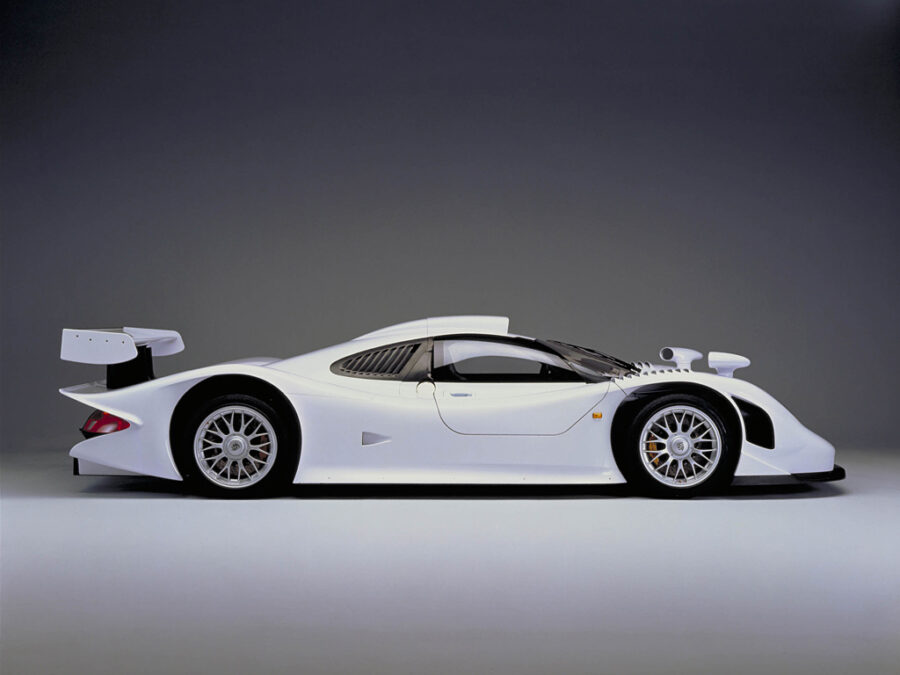
Each car was hand-built at Porsche’s Weissach facility, with meticulous attention to detail throughout the construction process. The interior, while spartan by luxury car standards, featured high-quality materials and racing-inspired touches, including carbon fiber trim and lightweight bucket seats.
Racing Success
The GT1’s racing pedigree speaks volumes about its engineering excellence. The competition version achieved remarkable success in endurance racing, including overall victories at the 24 Hours of Le Mans in 1996 and 1997. These triumphs validated the car’s design philosophy and cemented its place in motorsport history.

The homologation special allowed privateers and racing teams to campaign their own GT1s in various series, spreading the car’s influence throughout the racing world and demonstrating its versatility across different competitive environments.
Legacy and Impact
The GT1 Strassenversion represents a pivotal moment in Porsche’s history, marking the company’s successful return to top-level endurance racing while creating one of the most technically advanced road cars of its era. Its influence can be seen in subsequent Porsche models, from the Carrera GT to the modern 918 Spyder, all of which borrowed design philosophy and technical solutions pioneered by the GT1.
Today, the GT1 Strassenversion stands as a testament to what can be achieved when racing requirements drive road car development. Its combination of cutting-edge technology, racing pedigree, and extreme rarity has made it one of the most sought-after collector cars in the world, with values reflecting its status as a true automotive icon.
Conclusion
The Porsche 911 GT1 Strassenversion remains a unique achievement in automotive engineering – a car that successfully translated pure racing technology into a road-legal package without compromise. Its brief production run and exceptional capabilities ensure its place not just in Porsche’s illustrious history, but in the broader narrative of automotive excellence. For those fortunate enough to experience one, the GT1 offers a glimpse into what happens when racing breeds the ultimate road car.

